
Hi, I’m Momo, your resident gadget nerd 🍑
A year after its launch, I want to revisit a question: what exactly was the iPhone Air? This is less a conventional review and more a gadget enthusiast letting her opinions loose!
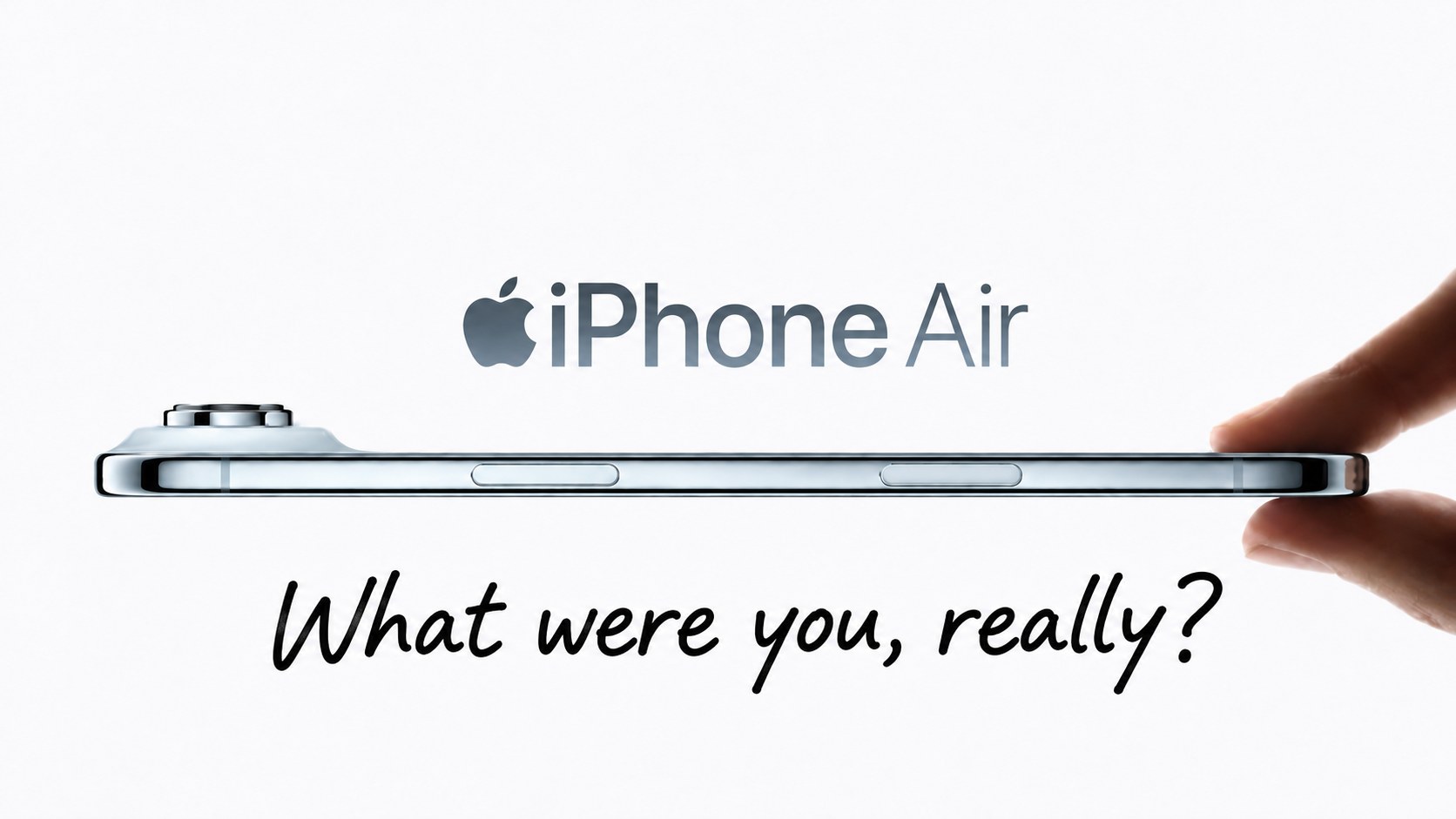
The iPhone Air arrived in 2025 with a startlingly thin 5.64 mm body ☁ Technically impressive, and certainly distinctive. But put it beside the same year’s iPhone 17, and I find myself wondering: who was this really the right purchase for?
My answer upfront: this phone definitely isn’t my usual type 💔 Still, it has real appeal for people who value thinness. I think it also met some of the demand from people left without a new iPhone mini. And viewed in the context of Apple as a company, the concept isn’t bad.
I’m writing as a committed gadget nerd, so I won’t sit on the fence. But I hope even iPhone Air fans will understand where I end up 🍑
This article discusses official specifications and published reporting. It is not a hands-on review. It preserves the original article’s information date of October 21, 2026; dated prices and release plans below describe that context, not a fresh market update.
First, Momo’s take 🍑
This part is a long one! These are personal opinions based on building PCs and using smartphones, not universal truths that apply to every product.
For ordinary PCs and phones, I generally think a sensible amount of space—or a little more—is a good thing. I’ve built quite a few computers and owned plenty of phones. Very few products I’ve encountered became better all-round computers, including their price, simply because they got smaller. Maybe the early Mac mini was an exception? 🦮
The iPhone Air seems to illustrate a similar trade-off. Older laptops sometimes felt like twice the price and half the performance of a desktop: a quarter of the value! Cooling could struggle, leaving them hot, throttling, or barely working properly. Modern laptops have improved enormously, and I’m certainly not saying every old one was like that.
The same applies to DIY PCs. With comparable components, smaller cases often make cooling and component selection harder. Options shrink and costs can rise. Trying to squeeze a powerful CPU into a tiny case could be a nightmare—although affordable all-in-one liquid coolers have changed things somewhat.
Anyone familiar with PCs or phones can probably picture the trade-off between miniaturization and cooling. Put a hot, high-performance SoC into that limited space without a vapor chamber, and heat dissipation becomes a major question, doesn’t it? The history of mobile CPUs and SoCs has always involved balancing performance, power consumption, and cooling.
Some people say, “Just leave it alone and it’ll cool down.” My old overclocking instincts want to yell, “The chip’s already suffering when it’s that hot! 🔥” But I don’t have strong evidence for that claim about mobile SoCs, so I won’t present it as a fact. As a former overclocker, I simply have an almost instinctive dislike of a very hot CPU 🧬
Then there’s the Air. It has an A19 Pro, positioned above the iPhone 17’s A19, yet the reference AnTuTu v10 results discussed here place it below the 17. Independent testing has also shown performance falling under sustained load.
Benchmark results depend on test conditions. The Air isn’t slower in every task, and I’m not claiming heat explains every lower score. But if prioritizing thinness makes cooling difficult enough that the higher-end SoC cannot always deliver its potential…
“You, the customer, still get to pay for that powerful chip!”
That’s the part I find hardest to accept. I know the responses: “It wasn’t designed for that kind of workload,” or “It’s fast until it heats up.” But then I want to say: don’t sell me on that performance!
Even at the same price, I might have found an A18 and an honest explanation—“We didn’t aim for peak performance; we poured our development effort into thinness”—easier to understand 🍑
The Air also uses titanium, which conducts heat less readily than aluminum. I understand the need for strength in such a thin body, and frame material alone doesn’t determine overall cooling. Even so, paired with a powerful SoC, it’s a choice I can’t help questioning.
Then there’s the single rear camera. And mono sound?! I’m disappointed.
Let me use a car analogy. Concept cars appear every year—the sort whose names always seem to contain an “X,” haha. Many never reach production unchanged. Attractive design and technology still have to meet reality: cost, usability, and manufacturing.
I welcome manufacturers pursuing bold ideas and showing their own character! But is it fair to make customers pay for the compromises needed to achieve those ideals without explaining them properly? If someone understands and accepts the trade-offs, that’s absolutely fine. I just wonder how many buyers really knew what they were choosing.
That’s roughly where I stand 🍑 The independent measurements cited below should be distinguished from my own judgments and speculation.
What was the iPhone Air trying to be?
The iPhone Air launched on September 19, 2025. Its defining feature was the thinnest body in iPhone history: 5.64 mm thick and 165 g. It also offered a large 6.5-inch display, ProMotion up to 120 Hz, an A19 Pro chip, and a titanium design.
To me, it was almost a concept model aiming for an exceptionally thin, light, high-end experience. I genuinely found the arrival of such a daring iPhone exciting!
| Item | iPhone Air |
|---|---|
| Launch date | September 19, 2025 |
| Japan launch price | From ¥159,800 (256 GB) |
| SoC | A19 Pro: 6-core CPU / 5-core GPU |
| AnTuTu v10 (reference) | Approximately 2.1 million |
| RAM | 12 GB (reported from Xcode 26 analysis; not disclosed by Apple) |
| Storage | 256 GB / 512 GB / 1 TB |
| Display | 6.5-inch OLED / up to 120 Hz |
| Rear camera | 48 MP Fusion main; optical-quality 2× |
| Front camera | 18 MP Center Stage |
| Battery | Up to 27 hours of video playback (Apple claim) |
| Charging | Up to 50% in 30 minutes / MagSafe up to 20 W |
| SIM | eSIM only |
| Water/dust resistance | IP68 |
| Thickness / weight | 5.64 mm / 165 g |
Prices are Apple’s Japanese launch prices from 2025, not current prices as of the original article’s October 21, 2026 information date. Thickness is the nominal body specification. AnTuTu v10 values are approximate third-party reference figures, not Apple specifications, and vary with test conditions. Another test cited by the original article measured about 2.11 million for Air and 2.37 million for iPhone 17. The 12 GB RAM figure comes from reporting based on Xcode 26 analysis, not an Apple-published specification. Source links appear below.
The iPhone 17 being so good was another problem
You can’t discuss the Air without the standard iPhone 17, also released in 2025. It even received up to 120 Hz refresh rates, once reserved for higher-end models. Let’s compare them at launch.
| Item | iPhone Air | iPhone 17 |
|---|---|---|
| Launch price (256 GB) | ¥159,800 | ¥129,800 |
| SoC | A19 Pro | A19 |
| RAM (reported) | 12 GB | 8 GB |
| AnTuTu v10 (reference) | About 2.1 million | About 2.5 million |
| Display | 6.5 inches / 120 Hz | 6.3 inches / 120 Hz |
| Thickness | 5.64 mm | 7.95 mm |
| Weight | 165 g | 177 g |
| Rear cameras | 48 MP main ×1 | 48 MP main + 48 MP ultrawide |
| Video playback (claimed) | Up to 27 hours | Up to 30 hours |
| MagSafe (maximum) | 20 W | 25 W |
| Physical SIM, Japanese model | Not supported | Not supported |
This compares equal storage capacities at Japanese launch prices and Apple’s published specifications. RAM is reported, not officially disclosed by Apple. Benchmark figures are approximate, not directly comparable guarantees; the other test noted above produced different results.
The Air was 2.31 mm thinner and 12 g lighter, but cost ¥30,000 more at launch. Of course that money didn’t buy thinness alone: you also got an A19 Pro, an extra 0.2 inches of screen, and a titanium frame in a lighter phone!
Even so, the 17 had an ultrawide camera and longer claimed video playback. Wouldn’t plenty of people think, “Why not just get the 17?” 🐽
And the cost of those 2.31 mm wasn’t only ¥30,000: it was an ultrawide camera, 543 mAh of battery capacity, and stereo speakers! That sounds harsh, but thinness has a value you can’t simply calculate by adding up specifications 🍑
The 543 mAh difference uses EU-registered rated capacities: 3,149 mAh for Air and 3,692 mAh for iPhone 17. These are not Apple’s video-playback ratings.
Actually, I considered buying one too, haha
There’s an extremely rational reason for this—not an attempt to flatter Apple!
I’ve carried both an iPhone and an Android phone for years 📱📱 I still do: a regular-sized iPhone and a larger Android. And the Air can actually make sense for people like me!
Calls, contactless payments, banking, credit cards, and work all go on my iPhone. Videos, music, web searches, and a little blog writing go on Android. So what I need from the iPhone is adequate performance, reliability, and compactness. Battery endurance and good speakers matter less to that phone because the workload is split between two devices.
Ironically, the Air fits my own use case remarkably well, haha. And despite everything I’ve said, I generally like Apple! Owning an unusual Apple model is appealing ✨
The simple reason I didn’t buy it: my current Android’s camera isn’t good enough. If that camera were a little better, I might have gone for the Air!
October 2026: unusually steep discounts made headlines
Roughly a year after launch, ITmedia Mobile reported on October 15, 2026 that the 1 TB iPhone Air was offered for ¥183,500 during an Amazon Prime appreciation sale promotion. The Apple Store price quoted for comparison at the time was ¥294,800. Those are striking numbers.
But be careful: reports also described Japanese Apple price increases in 2026. A discount of roughly ¥110,000 against a post-increase list price is not the same as the saving relative to the 2025 launch price.
Some reporting suggested excess inventory, but Apple had not officially acknowledged model-specific sales figures or declared the product a failure. A sale price alone does not prove poor sales. Facts and speculation need to stay separate.
These are historical, limited-time sale figures reported on October 15, 2026, not a promise of current pricing or availability.
Still, a discount can change the equation. Someone who wanted a 17 or Pro at the launch price might choose this thinness at another price. Being a good phone and being easy to recommend at full price are different questions.
Another meaning, seen through the iPhone Duo
In the original article’s October 2026 context, the foldable iPhone Duo was described as announced for 2026, with an October 23 release planned. This paragraph preserves that original account rather than providing an updated release-status check.
A large screen when open and a compact phone when closed is a different kind of experiment from the Air 📖 Yet I see a shared idea: rather than counting cameras, both are about rethinking how we carry a phone and what form feels comfortable. In that broader attempt to reconsider the smartphone’s shape, the Air can be seen as a meaningful step 🍑
So what was the iPhone Air? Momo’s conclusion
I think it’s too early to dismiss the iPhone Air as a failure. It wasn’t simply smaller or cheaper. It deliberately traded features to serve people who wanted a thin, light iPhone with a large screen.
It certainly wasn’t an all-rounder. If a friend asked me, the cameras, battery, and launch pricing would probably lead me to recommend the iPhone 17.
But for someone who never uses ultrawide, always wears headphones, and wants a large screen in the thinnest, lightest package, the Air has a unique appeal! A phone that sells to everyone and a phone that’s perfect for someone aren’t the same thing 🍑
My conclusion: technically revolutionary, but a little different from the usual answer to what makes a well-rounded smartphone.
One last thing matters enormously: Apple confidently put forward this distinctive iPhone. Wanting that special model is itself a perfectly understandable reason to buy it!
“Forget the details! One camera is enough! I love this phone!” That’s a lovely choice too. Your phone is the companion you keep with you, the thing in your hand when you reach someone you care about far away. Loving it may be its most important feature 🍑
As for me, paying the original launch price out of my own overworked-person budget… I’d probably still pick the 17 🤣 I like thinness, but accepting that ¥30,000 difference and losing the ultrawide is a difficult decision!
Which side are you on: “Make it thinner!” or “Use that space for more battery!”? 🍑
Original information date: October 21, 2026. Commentary based on published information; not a hands-on review.